How to Register for the RES Exam 2026: Step-by-Step Guide
Before you can sit the RES exam, there are a few gates to clear: you have to meet the eligibility rules, complete the compulsory RES course, and register for a sitting through the official exam administrator. This guide walks through eligibility, the course prerequisite, how registration works, the fees, and the exam schedule — so you know exactly what to do and what to budget. Because the authorities update rules, fees and dates from time to time, always confirm the current details on cea.gov.sg and res.ntuclearninghub.com before you commit.
Who runs the RES exam?
The property agency industry in Singapore is regulated by the Council for Estate Agencies (CEA). The Real Estate Salesperson (RES) examination itself is conducted by NTUC LearningHub, and you register for a sitting online at res.ntuclearninghub.com. Passing the exam is a key step on the path to becoming a registered salesperson — see our full guide on how to become a property agent in Singapore.
Are you eligible?
To register for the RES exam you need both of these:
- A valid Certificate of RES Course Completion from a CEA-approved course provider. It is valid for two years, and you can sit the exam any time within that window (CEA). Each sitting sets its own cut-off: for 31 Oct / 1 Nov 2026 it was 16 Sep 2026, about six weeks before Paper 1.
- At least 4 GCE "O" Level passes or an equivalent when you register for the exam. The O Level results can be combined from no more than two sittings (NTUC LearningHub, CEA).
The minimum age of 21 and the fit-and-proper test apply later, when you apply to register as a salesperson with CEA after you pass — not when you sit the exam.
The course comes first
The compulsory RES course
Everyone sitting the RES exam must first complete the preparatory course run by a CEA-approved course provider. It covers the syllabus you'll be tested on — land law, contract and agency, regulation and ethics, anti-money-laundering, stamp duties and property finance, and the practical side of transactions. The course qualifies you to register, but it doesn't guarantee a pass: most people who fail simply didn't practise enough afterwards. See how to pass the RES exam for the study plan first-time passers use, and how long to study for the RES exam to work out your timeline.
How to register, step by step
Registration is a two-stage process, and the first stage is time-critical — miss its short window and you wait until the next sitting. Here's exactly how it works, in order.
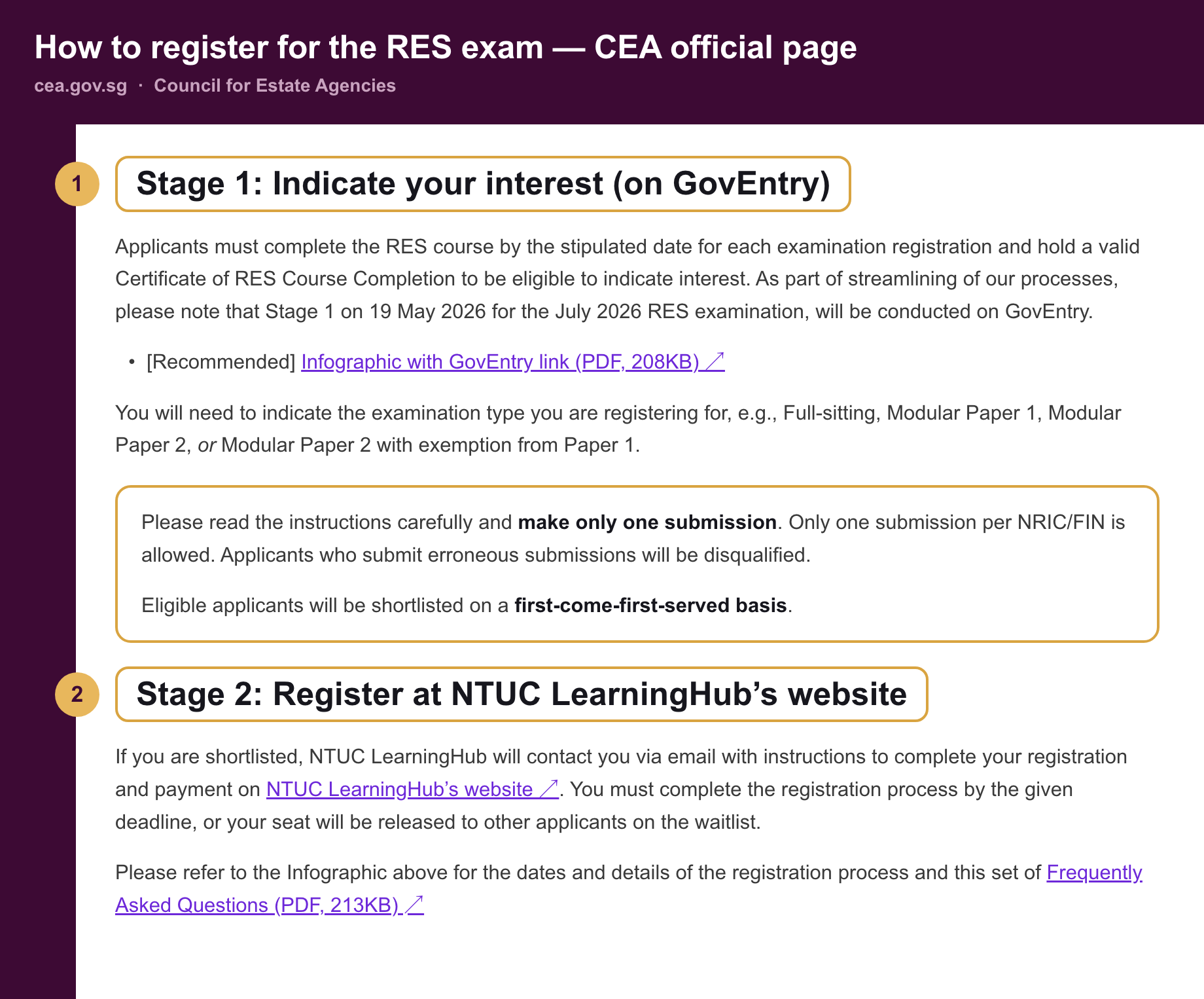
The two stages at a glance
Stage 1 — Indication of Interest (IOI)
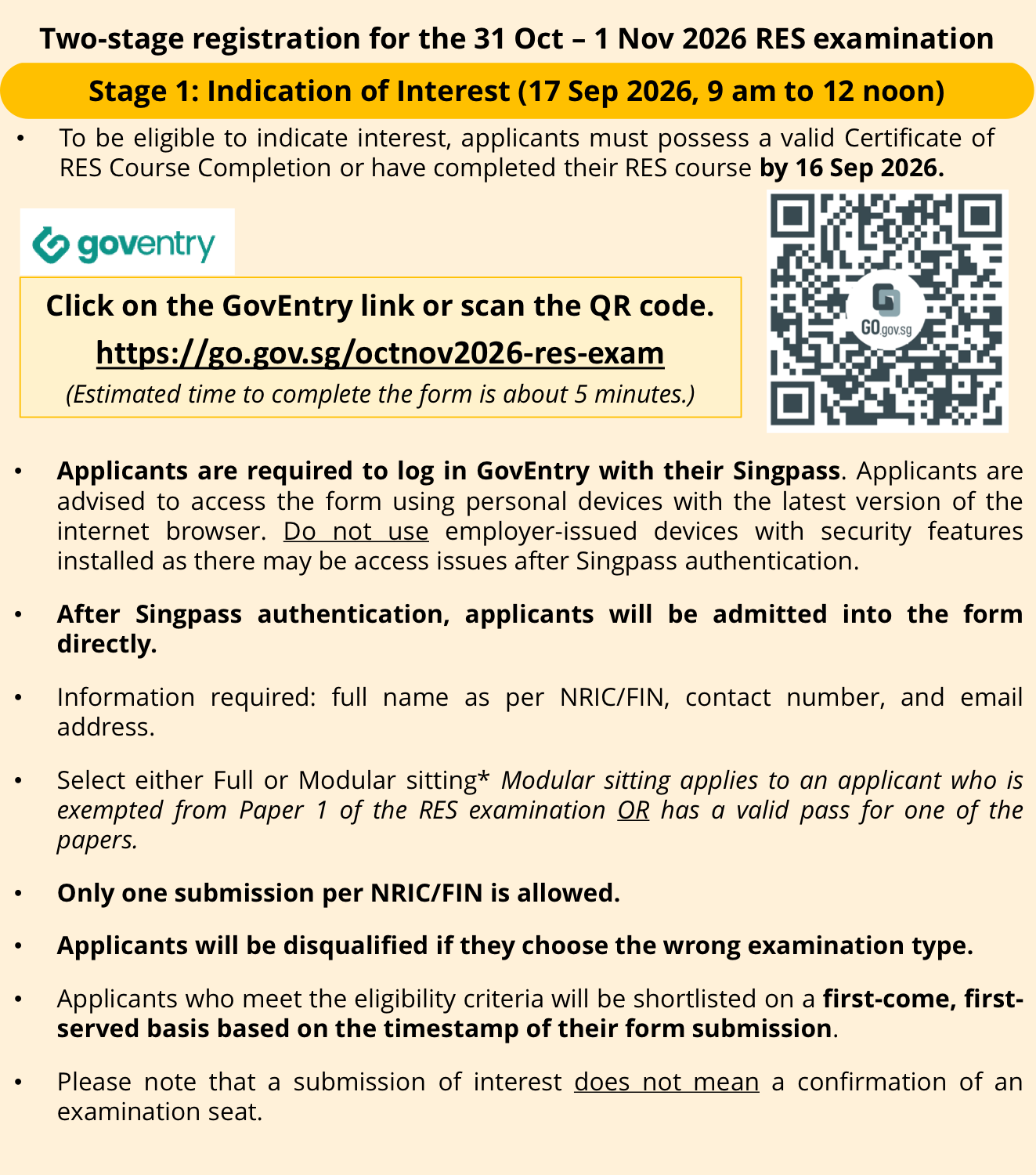
You don't book the exam directly. First you submit an Indication of Interest— how the authorities confirm who intends to sit. It's done on the government GovEntry portal (Singpass login), and it opens for a single short window — typically about three hours on one morning (around 9am–12pm) — roughly two months before the sitting. For the 31 Oct / 1 Nov 2026 sitting CEA set it for Thursday 17 September 2026, 9am to 12 noon, on go.gov.sg/octnov2026-res-exam — and you had to hold a valid Certificate of RES Course Completion, or have completed the course, by 16 Sep 2026. The form takes about 5 minutes. (CEA two-stage registration infographic, as at 12 Sep 2026 — always re-check cea.gov.sg.)
First-come, first-served — be ready at 9am sharp
What Stage 1 asks of you, step by step:
- Before the day —confirm you hold a valid Certificate of RES Course Completion, or have completed the course by that sitting's cut-off (16 Sep 2026 for 31 Oct / 1 Nov 2026).
- Use a personal device with an up-to-date browser. CEA warns against employer-issued laptops or phones with security software, which can block the form after Singpass login.
- Step 1 — the moment the window opens (9am on the published date — 17 Sep 2026 for this sitting), open go.gov.sg/octnov2026-res-exam or scan the QR code on CEA's infographic below.
- Step 2 — log in with Singpass. You go straight into the form.
- Step 3 — enter your full name as per NRIC/FIN, contact number and email address.
- Step 4 — choose the exam type: Full sitting (Paper 1 and Paper 2), Modular Paper 1, Modular Paper 2, or Modular Paper 2 with exemption from Paper 1. Modular applies only if you are exempt from Paper 1 or already hold a valid pass for one paper. Choosing the wrong type disqualifies you.
- Step 5 — submit. Eligible applicants are shortlisted first come, first served on the timestamp of their submission. A submission is not a confirmed seat — NTUC LearningHub emails the shortlisted by 30 Sep 2026.
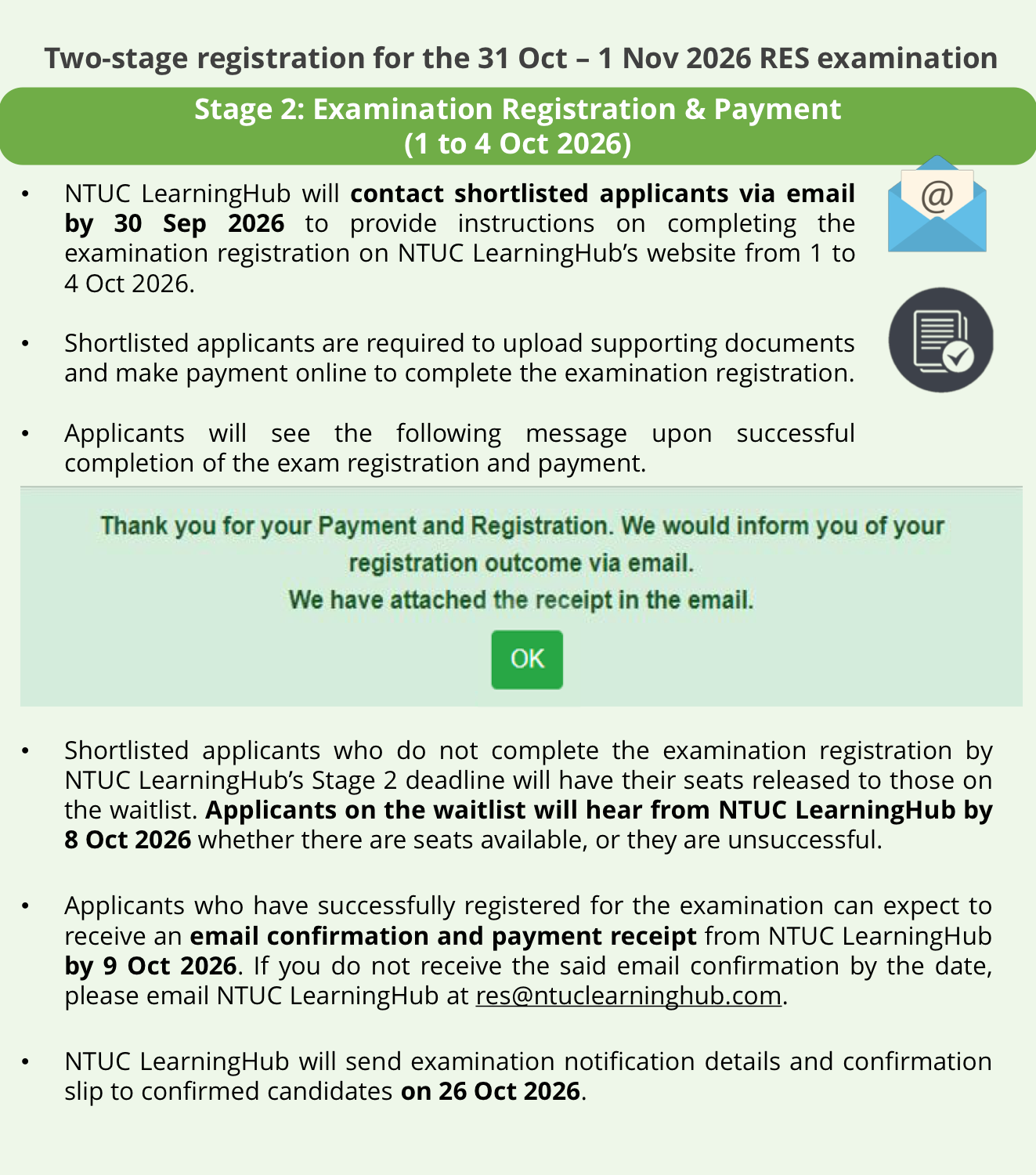
Stage 2 — Registration & payment (NTUC LearningHub)
If you're selected, NTUC LearningHub emails you with instructions to complete your registration and pay at res.ntuclearninghub.com. For the 31 Oct / 1 Nov 2026 sitting, LearningHub contacts shortlisted applicants by 30 Sep 2026 and the registration window runs 1 to 4 Oct 2026. Miss it and your seat is released to the waitlist, who hear by 8 Oct 2026. Expect your email confirmation and payment receipt by 9 Oct 2026, and the examination notification slip on 26 Oct 2026.
~30 minutes to finish, and the fee is non-refundable
Have these ready before you start (NTUC LearningHub):
- Your Certificate of RES Course Completion.
- Your academic qualification certificate, as a colour scan (GCE "O" or "A" Level, or equivalent).
- Your official transcript showing the conferment date, only if you are a BSc (Real Estate) or Diploma in Real Estate Business graduand without your certificate yet.
- Your CEA Assessment Letter, if your certificate is from a foreign or private institution.
- Your result slip, if you are taking a modular paper.
- A payment card for the fee (S$512.30 full / S$283.40 modular).
Files must be JPEG, PNG or PDF under 2MB, with no spaces or special characters in the file name. Use Chrome, Safari, Edge or Firefox.
The steps:
- Step 1 —open NTUC LearningHub's email (sent by 30 Sep 2026) and follow its registration link between 1 and 4 Oct 2026. Registration is by invitation only.
- Step 2 — upload your supporting documents.
- Step 3 —pay online. On success you see “Thank you for your Payment and Registration”, and the receipt follows by email.
How you'll know it worked
After Stage 1, NTUC LearningHub emails you by 30 Sep 2026 if you are shortlisted. After Stage 2, expect an email confirmation and payment receipt by 9 Oct 2026, then the examination notification and confirmation slip on 26 Oct 2026 — bring those details to the venue. If the 9 Oct email has not arrived, check spam, then email res@ntuclearninghub.com rather than assuming it went through.
When do you get your results?
CEA says results arrive within four to six weeks of the exam, by email — longer if many candidates sit. For the 31 Oct / 1 Nov 2026 sitting that points to late November to mid-December 2026. You need 60% to pass each paper and must pass both; if you pass one and fail the other, you re-sit only the failed paper at the modular rate. For how the result slip works, the appeal window and what to do once you pass, see RES exam results & what happens next.
RES exam fees
Beyond the RES course fee (which varies by provider), you pay an exam fee to NTUC LearningHub. The current fees, inclusive of GST, are:
| Fee type | What it covers | Fee (incl. GST) |
|---|---|---|
| Full sitting | Both papers (Paper 1 & Paper 2) | S$512.30 |
| Modular re-sit | One paper (the one you failed) | S$283.40 |
There is no refund once you pay, and none if you are absent. A deferment, allowed only in limited cases such as hospitalisation on the exam day, costs a non-refundable S$130.80 incl. GST per application (NTUC LearningHub).
If you pass one paper and fail the other, you re-sit only the failed paper at the modular rate — so budget for the possibility of a re-sit, and give yourself the best shot at a clean full sitting with a free timed mock before you book.
Exam format at a glance
Registration covers two papers, so it helps to know the structure before you book:
- Two papers, each 2 hours 30 minutes.
- Section A — 60 standalone multiple-choice questions.
- Section B — 20 case-study multiple-choice questions.
- You need 60% to pass each paper, and you must pass both. Fail one and you re-sit only that paper.
You are not tested on Government policy changes announced or implemented within one month before the exam (NTUC LearningHub), so for this sitting anything from about 1 Oct 2026 onwards is out of scope. For the full breakdown, see our RES exam format guide.
Exam schedule and sittings
There are three sittings in 2026, spaced roughly four months apart. Papers are held over a weekend — Paper 1 on Saturday and Paper 2 on Sunday, each starting at 9.30am. The confirmed 2026 sittings are:
| Sitting | Paper 1 (Sat) | Paper 2 (Sun) |
|---|---|---|
| March 2026 | 14 Mar | 15 Mar |
| July 2026 | 18 Jul | 19 Jul |
| Oct/Nov 2026 | 31 Oct | 1 Nov |
For the full sitting schedule plus the registration timeline — course deadline, Indication of Interest and payment windows — see our RES exam dates & schedule guide.
Venue and what to bring
The exam is paper-based at SIM Headquarters, 461 Clementi Road, Singapore 599491 (NTUC LearningHub). Bring your NRIC/FIN for identity verification, arrive early, and follow the notification slip sent on 26 Oct 2026. For a step-by-step run-through of the day itself, see what to expect on RES exam day.
After you register: get exam-ready
Registering is the easy part — clearing 60% on both papers is what counts. The most reliable path is to practise a high volume of exam-style questions, review every mistake, and lock the numbers cold with our one-page cheat sheet. Drill questions by topic, confirm your readiness with full mocks, and you'll walk in prepared. Create a free account to get started — the first 15 questions in every topic are free.
Frequently asked questions
Who is eligible to take the RES exam?
You need a valid Certificate of RES Course Completion (valid for two years) and at least 4 GCE 'O' Level passes or an equivalent when you register for the exam. The minimum age of 21 applies later, when you register as a salesperson with CEA after passing.
Do I need to complete a course before the RES exam?
Yes. The RES Preparatory Course from a CEA-approved course provider is a prerequisite to register for the examination.
How much does the RES exam cost?
From the July 2024 examination, NTUC LearningHub charges S$512.30 for a full sitting of both papers and S$283.40 for a modular re-sit of one paper, both including GST. The RES course fee is separate and varies by provider.
Go deeper: key RES concepts
Put it into practice
Free account, 2,600+ exam-style questions, instant explanations and timed mock exams.
Get each day's lesson free — one RES topic + the trap, every day on Telegram.
Join @resprepsg →